Sanitary Medical School of Applied Sciences
FOOD ALLERGY
CONTENT
1.Key words………………………1
2.Apstract…………………………2
3.Indtroduction ………………….. 3
4.Simptomes ……………………..4
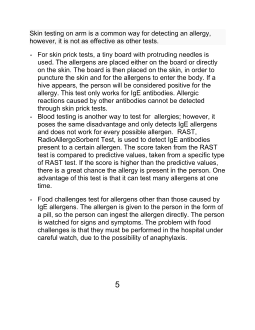
5.Diagnosis ………………………4
6.Prevention ……………………..6
7.Treatment ……………………...8
8.Literature………………………14
APSTRACT
Food allergy is abnormal rection to
food(peanuts,fish,shellfish,eggs,milk).The most common food
allergy symptoms include:tingling mouth;hives;swelling of the
lips,face;wheezing,nasal congestion;abdominal
pain,diarrhea,nausea;dizziness.Diagnosis of food allergy
is:Detailed history,diet diary,elimination diet,skin test,blood
test,oral food challenge.The mainstay of treatment for food allergy
is avoidance of the foods that have been identified as allergens.
For people who are extremely sensitive, this may involve the total
avoidance of any exposure with the allergen, including touching or
inhaling the problematic food as well as touching any surfaces
that may have come into contact with it.If the food is accidentally
ingested and a systemic reaction (anaphylaxis) occurs,
then epinephrine should be used. It is possible that a second dose
of epinephrine may be required for severe reactions.There are
treatments for an allergic reaction. Among the first time the
reaction occurs, it is most beneficial to take the person to
the emergency room, where proper action may be taken. Other
treatments include: epinephrine, antihistamines, and steroids
.
2
Food allergy is an abnormal response to a food triggered by your
body's immune system.
In adults, the foods that most often trigger allergic reactions
include fish, shellfish, peanuts, and tree nuts, such as walnuts.
Problem foods for children can include eggs, milk, peanuts, tree
nuts, soy, and wheat.
The protein in the food is the most common allergic component.
These kinds of allergies occur when the body's immune system
mistakenly identifies a protein as harmful. Some proteins or
fragments of proteins are resistant to digestion and those that are
not broken down in the digestive process are tagged by the
Immunoglobulin E (IgE). These tags fool the immune system into
thinking that the protein is is an invader. The immune system,
thinking the organism (the individual) is under attack, sends white
blood cells to attack, and that triggers an allergic reaction. These
reactions can range from mild to severe. Allergic responses
include dermatitis,gastrointestinal and respiratory distress,
including such life-threatening anaphylacticrespones as biphasic
anaphylaxis and vasodilation; these require immediate
emergency intervention. Individuals with protein allergies
commonly avoid contact with the problematic protein. Some
medications may prevent, minimize or treat protein allergy
reactions. There is no cure.
Treatment consists of either immunotherapy(desensitisation) or
avoidance, in which the allergic person avoids all forms of contact
with the food to which they are allergic. Areas of research include
anti-IgE antibody (omalizumab, or Xolair) and specific oral
tolerance induction (SOTI), which have shown some promise for
treatment of certain food allergies. People diagnosed with a food
allergy may carry an injectable form of epinephrine such as an
EpiPen, or wear some form of medical alert jewerly, or develop
an emergency action plan, in accordance with their doctor.
3