REPUBLIC OF SERBIA
COLLEGE OF APPLIED PROFESSIONAL STUDIES IN
VRANjE
Seminar paper
Subject: English language 2
Theme: Aircraft
Professor Student
dr Maja Stanojević Gocić Dejan Cvetanović, 221/MI
Vranje, april, 2016.
Seminar paper Theme: Aircraft
Dejan Cvetanović, 221/MI 2
CONTENTS
1. A brief history of aircraft structures
3
1.1.General
3
1.2.Major Structural Stresses
5
1.3. Fuselage
6
1.4. Wing Configurations
9
1.5.WingStructure
10
1.6. Empennage
11
1.7. Primary Flight Control Surfaces
12
1.8. Landing Gear
14
1.9. The Powerplant
16
1.10. Instrumentation: Moving into the Future
17
1.11.Performance Instruments
18
1.12. Control Instruments
18
1.13. Navigation Instruments
19
Literature
20
Seminar paper Theme: Aircraft
Dejan Cvetanović, 221/MI 4
Figure 1.2.
Examples of different categories of aircraft, clockwise from top left: lighter-than-air, glider,
rotorcraft, and airplane
By contrast, propellers and rotating airfoils of an engine on an airplane are not considered part of
the airframe. The most common aircraft is the fixed-wing aircraft. As the name implies, the wings on this
type of flying machine are attached to the fuselage and are not intended to move independently in a fashion
that results in the creation of lift.
One, two, or three sets of wings have all been successfully utilized. [Figure 1.3] Rotary-wing aircraft
such as helicopters are also widespread. This handbook discusses features and maintenance aspects
common to both fixedwing and rotary-wing categories of aircraft. Also, in certain cases, explanations focus
on information specific to only one or the other. Glider airframes are very similar to fixedwing aircraft.
Unless otherwise noted, aintenance practices described for fixed-wing aircraft also apply to gliders. The
same is true for lighter-than-air aircraft, although thorough coverage of the unique airframe structures and
maintenance practices for lighter-than-air flying machines is not included in this handbook.
Figure 1.3.
A monoplane (top), biplane (middle), and tri-wing aircraft (bottom)
Seminar paper Theme: Aircraft
Dejan Cvetanović, 221/MI 5
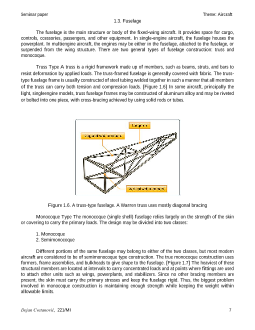
The airframe of a fixed-wing aircraft consists of five principal units: the fuselage, wings, stabilizers,
flight control surfaces, and landing gear. [Figure 1.4] Helicopter airframes consist of the fuselage, main
rotor and related earbox, tail rotor (on helicopters with a single main rotor), and the landing gear. Airframe
structural components are constructed from a widevariety of materials. The earliest aircraft were
constructed primarily of wood. Steel tubing and the most common material, aluminum, followed. Many
newly certified aircraft are built from molded composite materials, such as carbon fiber. Structural members
of an aircraft's fuselage include stringers, longerons, ribs, bulkheads, and more. The main structural member
in a wing is called the wing spar. The skin of aircraft can also be made from a variety of materials, ranging
from impregnated fabric to plywood, aluminum, or composites. Under the skin and attached to the structural
fuselage are the many components that support airframe function. The entire airframe and its components
are joined by rivets, bolts, screws, and other fasteners. Welding, adhesives, and special bonding techniques
are also used.
Figure 1.4.
Principal airframe units
1.2. Major Structural Stresses
Aircraft structural members are designed to carry a load or to resist stress. In designing an aircraft,
every square inch of wing and fuselage, every rib, spar, and even each metal fitting must be considered in
relation to the physical characteristics of the material of which it is made. Every part of the aircraft must be
planned to carry the load to be imposed upon it. The determination of such loads is called stress analysis.
Although planning the design is not the function of the aircraft technician, it is, nevertheless, important that
the technician understand and appreciate the stresses involved in order to avoid changes in the original
design through improper repairs. The term "stress" is often used interchangeably with the word "strain."
While related, they are not the same thing. External loads or forces cause stress. Stress is a material's internal
resistance, or counterforce, that opposes deformation. The degree of deformation of a material is strain.
When a material is subjected to a load or force, that material is deformed, regardless of how strong the
material is or how light the load is. There are five major stresses [Figure 1.5] to which all aircraft are
subjected:
Tension
Compression
Torsion
Shear
Bending