1
VISOKA ZDRAVSTVENA ŠKOLA
STRUKTOVNIH STUDIJA
“MEDIKA”
BEOGRAD
ENGLISH LANGUAGE
SEMINARY WORK
Topic:
Cardiovascular disease -
Heart and blood vessel diseases
Mentor:
Student:
BELGRADE
4
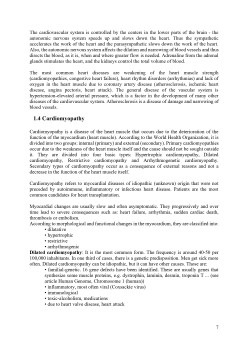
External shape of the heart: The heart weighs about 270 g. It has the shape of a three-sided
pyramid, whose axis is directed to the left and down. The anterior chambers have a small
expansion and are located behind the corresponding chambers. The boundary between the atria
and the ventricles is marked on the outside by a circular crown groove. There is an arterial
pulmonary trunk on the front of the heart, and an aorta behind it.
The base of the heart consists of the right atrium, which continues upwards with the upper vena
cava, and downwards with the lower vena cava, and the left atrium, into which the four
pulmonary veins flow.
Internal appearance: The right and left cavities are separated from each other by an
interventricular and anterior atrial septum. On the right side of the atrial septum, an oval pit is
observed, the rest of Botal's opening, which allows the blood in the fetus to bypass the small
bloodstream. At the base of the chambers there are two circular openings:
Atrium - ventricular orifices, through which the atria communicate in the chambers. At these
ears, there is a valvular apparatus (valves), which prevents the return of blood from the
chambers to the atria. There is a three-leafed valve on the right ear, and a two-leafed valve on the
left.
Arterial orifices through which the left ventricle communicates with the aorta and the right with
the pulmonary artery. At these ears, there are three crescent-shaped valves that form obstacles in
the shape of a swallow's nest and prevent the return of the squeezed blood to the heart chambers.
The wall of the ventricles is rough due to the muscular bulges to which the connective bands are
attached, connected to the mitral and tricuspid valves which keep them in the required position.
On the upper side of the right atrium, there is the mouth of the upper vena cava and the coronary
sinus. There are four ears of pulmonary veins on the back wall of the left atrium.
Picture 1. The human heart
1.1 Histology and physiology of the heart
5
The heart wall consists of three layers: the thick muscular layer (myocardium), the inner layer
(endocardium), and one membrane that surrounds the heart wall (pericardium). Vascularization
of the heart is provided by two coronary arteries that separate from the initial part of the aortic
arch. The spread of myocardial contractions takes place through a special system of nerve
fibers, which is located in the heart muscle, and consists of Kate and Fleck's node located in the
right atrium, Asof-Tavarin node, as well as His snap, which connects the ventricular and atrial
muscles. His bundle extends along the interventricular septum and eventually divides into two
branches, left and right.
The heart contracts 60-70 times a minute in adults. It simultaneously pushes blood from the
right ventricle into the lungs and from the left ventricle into all other parts of the body. This
ventricular systole is preceded by short-term atrial systole during which the ventricles fill with
blood, followed by a resting phase of the heart (diastole), when the atria fill and the cycle begins
again. The valves play a major role as a valve in the atrio-ventricular and arterial openings. The
heart has automatism: even when it is taken out of the organism, it continues to contract
spontaneously. In fact, the normal stimulus for a heart contraction starts from the Kate-Fleck
node, then the impulse spreads to the Asof-Tavara node and reaches the ventricles via the His
bundle. In this way, a successive contraction of the atria and then the ventricles is provided, with
a normal rhythm called sinus rhythm. The heart is subject to the action of the neuro-vegetative
system: the parasympathetic nerve slows down the heart rhythm, and the sympathetic nerve
speeds it up.
1.2 General blood flow scheme
The heart sends venous blood to the lungs through the pulmonary artery, which is contained in
the right ventricle. As it passes through the pulmonary capillaries, where it is released from CO2
and where it is enriched with oxygen, the blood reaches the left atrium through the pulmonary
veins: it is a cycle of small blood flow. As it passes from the left atrium to the right ventricle,
blood enters the great bloodstream through the aorta and its branches, then passes through
capillaries, where it delivers some of its oxygen to the tissues, receives CO2, and through the
venous system reaches the vena cava and right atrium: large blood flow cycle. As it passes from
the right atrium to the right ventricle, the blood reaches the lungs again and the cycle repeats.