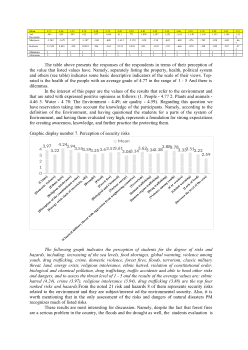
Recognition and perception of risks and Environmental hazards on the
part of the student population in the Republic of Macedonia
Aleksandar Ivanov, PhD
Faculty of Security – Skopje, Skopje, Idrizovo, Macedonia
[email protected]
Vladimir M. Cvetković, PhD candidate
The Academy of Criminalistics and Police studies, Belgrade, Serbia
Srna Sudar, PhD Student
Director of the Regional Environmental centre in Montenegro
[email protected]
Abstract:
The subject of quantitative research in this paper is analysis of the knowledge and the
perceptions of students from seven different faculties in different years of study. The authors used
quantitative survey method to identify and describe the knowledge and the perceptions about the
possible risk and disasters. 382 students from all years of study were examined. The results show
that the respondents have a high level of knowledge on natural disasters and that there is a
significant difference among students depending mostly on the year of study. There is also a
difference in some perceptions between the students from “nonsecurity” and from “security”
studies. The limitation of the research refers to the fact that the investigation is based only on
students willing to participate in the answering of the questionnaire. Considering the evident lack
of risks and hazards related to the Environment in Macedonia, the survey results can be used when
creating the strategy of educational programs, which would contribute to improving the safety of
youth culture. The research results can also be used for the improvement of existing knowledge and
preparedness for responding to risks and hazards related to the Environment.
Keywords
: risks and hazards, students, knowledge, perception, environment
INTRODUCTION
Some sociologists, political theorists and anthropologists argue that the social and the
political changes are contributing how the risks and dangers are being perceived and how they are
administered in modern societies.The German theoretician Beck claims that we are in a state of
great transition from conventional into a "risk" society. In his book, a risk society, Beck claims that
fundamental appraisers of the acceptable level of risk in the future are going to be the insurance
companies. (Borodzicz, 2005, стр. 10)In the discussion, Beck establishes a theory that the modern
concepts of risks starting from the industrialization, are being controlled by the market. On the
question about how we can determine the boundary between risk and the threat, Beck says that "the
economy reveals the boundaries between what is tolerable with economic precision, through the
elimination of the insurance policy."In this paper we are considering the risks and threats as
synonyms.
The people in everyday life are trying to predict most of the things that happen. However,
in each basis of this prediction exists a set of activities with which practically we get our result of
what we have imagined. The concept of risk is closely related category with: prediction,
probability, sense of certainty, and by it, it is closely linked to the notion of danger.
The risk has different connotations and interpretations depending on the historical moment
and the explanations given by science. Today, it is recognized that the risk represents a measure or
a function of two variables, such as:1)The extent of the probability of failure; and 2) the
consequences of the failure. Usually the events that most sparsely can occur (this is unlikely) cause
serious consequences (as of 12/26/2004, the tsunami in Indonesia). And vice versa, events that it is
more likely that are going to happen usually can cause minor consequences. (Ganoulis & Simpson,
2006, стр. 245 – 246)
By consulting a number of authors (Wilkinson, Георгиева, Кун, Holton, Durodié and
others) Gerasimovski says that the risk is actually a term for an expected future, supervisor event
which is likely to occur, but not necessarily. So the risk is a probable event whose occurrence
depends on a complex web of factors that make up its content. (Герасимовски, 2010, стр. 117)The
risk unlike the uncertainty is stated that possesses a great difference, especially in terms of the
possibility of prediction (calculation). Hence, the risk can be graded on the basis of it to make
different decisions in different contexts and needs. In the discussion Gerasimovski concludes that
“the risk is possible, assumed, expected occurrence, probably happening with the possible positive
or negative outcome, but mostly negative (possible danger - negative risk)" (Герасимовски, 2010,
стр. 124). When it comes to the risks, the efforts of the people and societies are more to learn about
the nature, the type and the structure of the risk or the risks to be managed or controlled, or at least
as best possible extent with them to handle. (Герасимовски, 2010, pp. 128 – 129)
The usual explanation asscociates the risk with the possibility / probability of injury,
damage or loss. Most often, the probability and consequences of a violent act or event associated
with physical (technology) and natural processes according to how and whether it can be
objectively defined with risk assessment. We can conclude that the danger or the threat could be
real, but the risk, however, is a social construction. The process of assessing the risks is essentially
subjective and complicated resulting from the combination of the scientific approaches and assess
of psychological, social, cultural and political factors that are important for determination. Within
this process, which Slovic describes as a game in which social rules apply with respect to a
problem, the key problem is how to define risk. (Георгиева, 2006, стр. 83 – 84.)
Under threat in this paper we understand a broad definition that includes natural
phenomena and human activities, and technological failures that could cause damage or loss of
what is considered a subject of protection in the contemporary society, such as: life, health,
property, environment, physical integrity. Activities associated with the degree of probability of
endangering human health include the entire infrastructure that implies a modern society, as well as
the environment.
LITERARY REVIEW
The risks and the dangers are subject of intense scientific discussion in the economics,
politics, culture, security. We are looking for links between risk, crises, security (Borodzicz, 2005),
(Boin, Hart, Stern, & Sundelius, 2005), (Gunter Brauch, et al., 2011), (Belluck A. , Hull, Benjamin,
Alcorn, & Linkov, 2006), (Ganoulis & Simpson, 2006), the
Environment and the security
( (Малиш Саздовска, 2010), (Милески, Еколошка безбедност, 2006), (Милески, Еколошка
безбедност - одржлив развој – одржлива безбедност, 2011), (Barnett, 2001), (Deudney, 1990),
(Floyd, 2010), (Hulme, 2009), (Aipas, Berskowicz, & Ermakova, 2011), (Matthew, Barnett,
Macdonald, & O'Brien, 2010), (Simmons, 1999) (Dodds & Pippard, 2005), (Todorovič, 2009)and
others,
the Environment and the Sustainable development
(Roger (Atkinson, Dietz, & Neumayer,
2007), (Baker, Sustainable Development, 2006), (Baker, Kousis, Richardson, & Young, 1997),
(Danilov – Danil’yan, Losev, & Reyf, 2009) (Elliott, 2006), (Lafferty & Meadowcroft, 2000)
(Marten, 2001) and as a result of these discussions and academic research works it is quite sure that
interdependence is determined. The link between environment and all sciences exists because the
term environment signifies the entity of everything that is surrounding us, the totality of the dead
and the living nature into its total functioning and exchange.
The security, I would say, is a very "stretchable" concept. The individual elements of the
perception of security only further contribute to the possibly increasing differences into its
understanding.
The theoreticians in a global sense recognize the changing societies which are closely
related to access to information and the process of globalization. This process could be compared
with the recognition of transition from the feudal towards a capitalist society by Marx. Today,
according to Beck (Besk), in contemporary terms, we are talking about postindustrial, modern
society in which people are becoming concerned with the risks associated with the food we
The structure of the respondents is illustrated from the graphics display below no. 2 with a
56% respondends male and 44% of females.НMost of the respondents (336 students, representing
88)% are full-time students, while the rest are part-time students. Such a number as researchers had
surprised us because we did not expect the part time students to get involved in the research at all.
This speaks in favor of interest on the topic.
Graphic No. 2 represents the ethnic structure of the respondents indicating that the majority are
Macedonians, which corresponds to the organizational structure in which the survey is conducted.
Mace-
donians
Albanians Turks
Roma
Serbs
Vlachs Bosniaks
Other
0
50
100
150
200
250
300
350
0%
10%
20%
30%
40%
50%
60%
70%
80%
90%
100%
Macedo-
nians; 330
Albanians; 23
Turks; 5
Roma; 1
Serbs; 16 Vlachs; 4
Bosniaks; 2
Other; 2
86%
6%
1%
0%
4%
1%
1%
1%
Number
Процент
Bellow we can see the structure of respondents according to the Faculty where they are
studying.
Graphic display number 3. The structure of respondents according to faculty.
Faculty pf
Security -
Skopje
Faculty of
Law
"Iustinianus
Primus"
Faculty of
Theology
Faculty of
Law and
Faculty of
Detectives
on FON
University
Institute for
Defense,
Peace and
Security
Mechanical
Faculty and
forestry
faculty
from Skopje
the Military
Academy
0
20
40
60
80
100
120
140
116
68
7
54
55
49
33
Number of students
Moving average (Number of students)
RESULTS AND DISCUSSION
On the question what is the biggest threat students see for the environment in the Republic of
Macedonia, the graphics displayed bellow shows that the perception of threats related to the
environment among the student population is the following: for the majority air pollution is the
major problem with 74.08 % of respondents; then water pollution comes next with 68.58%,
chemical and bacteriological contamination, and then other types of pollution.
336
;
88
%
47
4. The structure of students
according to their status
Full time students
Par-time students
44%
56%
5. Gender
Male
Female