S E M A N T I K A E N G L E S K O G A J E Z I K A
m e n t a l i s m
implies that phenomena within language have a mental basis,
which means that language is not seen exclusively as an abstract system
existing on its own
a n t i – m e n t a l i s m
implies that language is seen as a structure which is in
no way related to any kind of psychological attributes of the human being
t h e o r i e s
have an explanatory function; they systemise the data according to
the general principles; on the basis of this systematisation things become
clearer
m e t h o d o l o g y
is a set of methods by means of which the postulates of the
theory are, hopefully, proven
l i n g u i s t i c c o n t e x t
: immediate syntagmatic environment in which a
linguistic element can appear (+ non-linguistic context + context of situation)
l i n g u i s t i c s
: the scientific study of language (language is seen as an
abstract system)
1916,
Saussure’s
“
Course on General Linguistics
” = the beginning of linguistics
as a science, and the beginning of structural linguistics
it is the scientific study of language which aims at explaining how language
functions
language is seen as a
unique system/structure
whose basic principles are
identified, explained and can then be applied to all languages
he distinguished between
synchronic
and
diachronic
research
he distinguished between ‘
langue’
, ‘
parole’
and ‘
langage’
(the totality of the
linguistic phenomena)
he started distinguishing between the psychological and sociological reality of
language
linguistic sign
is comprised of form and content (signifié and signifiant)
paradigmatic
and
syntagmatic
relations
o
syntagmatic
– linear; they are combinatory sequences determined by the two
sets of rules: those that determine how sequence can appear, and those that
are deliminated by possible choices
o
paradigmatic
– all the possibilities within language that can be interchanged
on the syntagmatic level
o
they pose a unity, i.e. function in unison
structuralism
developed in two major mainstreams
o
European
o
American
based on the psychological theory of behaviourism
very radical kind of anti-mentalism
1
basic
levels of linguistic analysis
from the traditional point of view (i.e. what
linguistics deals with):
o
phonology
o
morphology
o
syntax
o
lexicology
o
semantics
(studies the structure above individual words/phrases)
impact on other humanities
: they could function as a legitimate scientific
disciplines
s e m i o t i c s
: the scientific study of signs
Ogden and Richards
:
o
semioticians intrigued by meaning in natural languages
o
“
The Meaning of Meaning
” (1923): came up with 22 definitions of meaning
o
something radical should be done, through
analytical rigour
– meaning
must have some kind of structure; they say that analytical rigour is the only
way out within any linguistic discipline that deals with meaning
o
knowledge of the language and of the world depends on a cultural
background and on the direction of the development of a language
eng.:
trot > canter > gallop =
hrv.:
kas
> ? > galop
=>
lexical gap
galop je posuđenica iz engleskog jer to nije bila primarna uloga konja u
Hrvatskoj
o
triangle
symbol
is any item of language
reference
(‘thought’) is a mental vision that
we get when someone says something
referent
is a real word entity
meaning can be seen as a process; it is not
an entity
there is an arbitrary relation between a
symbol and a referent
REFERENCE
SYMBOL
REFERENT
Ullmann
SENSE
knowledge knowledge
of of
language the
world
NAME THING
Pierce
LEXICAL CONCEPT
LEXEME
DENOTATUM
the basic
f u n c t i o n s o f l a n g u a g e
(Leech)
se
m
an
tic
s
2
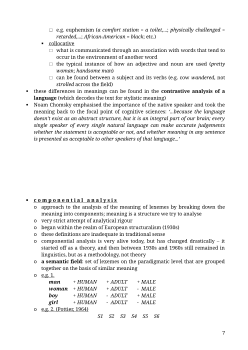
o
stresses the need for a separate discipline dealing with meaning, and he calls
it for the first time
semantics
o
in 1897 he writes his famous
“Essay on Semantics”
: official beginning of
semantics as a linguistic discipline
o
semantics should be seen as the integral part of any linguistic study; without
it, descriptions are unproductive and do not serve to understand how
language functions
the
related disciplines of semantics
(from the traditional point of view):
o
philology
a diachronical approach to languages, a descriptive way of viewing
languages until the beginning of the 20
th
century
its aim is to describe different notions in a vast number of mainly Indo-
European languages
philology > etymology + syntax (seen as a descriptive discipline)
o
etymology
part of philology; predecessor of contemporary semantics
deals with how words change in form and meaning over time
primarily a diachronic discipline
e.g.
brijati
: change in form (
brijati se
>
brijati
) and meaning (
brijati
=
brijati bradu
>
brijati
=
misliti
, i sl.)
o
lexicology
analysis of the lexemes of a language (i.e. the meaning of one
phonological sequence) and of certain set phrases
o
lexicography
scientific dissection of all the types of knowledge that we need to have in
order to produce a dictionary
dictionaries
: monolingual, bilingual, encyclopaedic (more scientific
information, extra information, pictures, etc; e.g. Webster’s), thesaurus
(conceptual dictionary; the basis of the organisation are the clusters of
concepts)
a good dictionary has two functions: to unveil anything one does not
know, and to unveil a new meaning one does not know yet
linguistic corpora
□
provide objective data for analysing linguistic phenomena
□
1
st
corpus: Brown Corpus (1960s), 1 million items amassed from 18
different kinds of texts
□
The National British Corpus: the biggest, more than 100 million items
□
The Bank of English: 200 million items
□
concordance: a list of examples that are represented in context
o
stylistics
text/discourse analysis in written and spoken language, applying to any
kind of text, whereas traditional definition related it specifically to
literature
4
dealing with varieties of style
the oldest,
traditional
notions of semantics
o
they more or less successfully describe some kind of phenomena, but do not
explain how these phenomena (i.e. their semantic side, their meaning)
actually function in language, nor where they come from
o
synonymy
absolute
□
completely same meaning
□
rare or even non-existent due to limited combinatory possibilities (of
phonemes in words)
□
John Lyons
: three criteria have to be satisfied by absolute synonymy
1) synonyms are fully synonymous if all their meanings are identical
2) synonyms are totally synonymous if and only if they are
synonymous an all contexts
3) synonyms are completely synonymous if and only if they are
identical in all relevant dimensions of meaning
□
his examples:
radio
=
wireless
(still used in Australian English: has a dialectal/stylistic
meaning);
airport
(today: with accompanying facilities, standard civil place for
air traffic) =
airfield
(today: for military purposes, or merely a strip of
land) =
aerodrome
(today: found in technical manuals) > differences in
the dimension of meaning
□
Croatian examples: apoteka = ljekarna; muzika = glazba, sustav =
sistem...
partial
□
large
&
big
: distinguished by the collocational range
□
flaw
(personal) &
defect
(mechanical) &
blemish
(skin complex):
collocational range, and context (experience)
□
huge
&
enormous
&
gigantic
&
colossal
: difference in expressive
meaning
o
polysemy
one word has several related meanings
e.g.
neck
(of a person, of a bottle, of a shirt...),
bat
(animal, baseball bat)
synchronic resemblance – we as speakers recognise it, feel it instinctively
these native-speaker feelings are based on metaphorical extensions
(popular etymology)
conceptual background of polysemy
o
homonymy
one word has more than one unrelated meaning
absolute homonyms
□
e.g.
bank
= financial institution / side of a river
□
criteria to be fulfilled
5