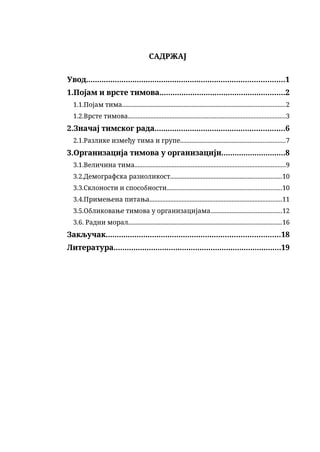
С А Д Р Ж А Ј
1.
Crete ...........................................................................................
1
1.1 The Origin of the name .................................................................
1
1.2 Geography .....................................................................................
1
1.3 Climate ...........................................................................................
6
1.4 History .............................................................................................
7
1.5Mythology ........................................................................................
9
2.
Minoan art ………………………………………………………
10
2.1Architecture ………………………………………………………...
11
2.2 Paintings ……………………………………………………………
13
2.3 Statuary ……………………………………………………………..
15
2.4 Pottery………………………………………………………………
16
3.
Music .............................................................................................
17
4. Conclusion ....................................................................................
19
2
Περιφέρεια Κρήτης), one of the 13 top-level administrative units of Greece. The capital and
the largest city is Heraklion. As of 2011, the region had a population of 623,065. It is located
in the southern part of the Aegean Sea separating the Aegean from the Libyan Sea.
Picture 1 :ΠεριφέρειαΚρήτης - The administrative region of Crete
The island has an elongated shape: it spans 260 km (160 mi) from east to west, it is 60
km (37 mi) at its widest point, and narrows to as little as 12 km (7.5 mi) close to Ierapetra.
Crete covers an area of 8,336 km2 (3,219 sq mi), with a coastline of 1,046 km (650 mi); to the
north, it broaches the Sea of Crete; to the south, the Libyan Sea in the west, the Myrtoan Sea,
and toward the east the Karpathian Sea.
3
Picture 2 :The island of Crete in astronaut photography taken from the International Space Station
Crete is formed by different groups of mountains:
The White Mountains (Lefka Ori 2,452 m), The Idi Range (Psiloritis 2,456 m) ,
Kedros(1,777 m ), The Dikti Mountains ( 2,148 m) and( Thripti 1,489 m).
These mountains lavished Crete with valleys, such as Amari valley, fertile plateaus, such as
Lasithi plateau, Omalos and Nidha; caves, such as Gourgouthakas, Diktaion, and Idaion (the
birthplace of the ancient Greek god Zeus); and a number of different gorges.The island has a
number of gorges, such as the Samariá Gorge, Imbros Gorge, Kourtaliotiko Gorge, Ha Gorge,
Platania gorge, the Gorge of the Dead (at Kato Zakros, Sitia) and Richtis Gorge and waterfall
at Exo Mouliana in Sitia.The rivers of Crete include the Ieropotamos River, the Koiliaris, the
Anapodiaris, the Almiros, the Giofyros, and MegasPotamos. There are only two freshwater
lakes: Lake Kournas and Lake Agia, which are both in Chania regional unit.LakeVoulismeni
at the coast, at Aghios Nikolaos, was formerly a sweetwater lake but is now connected to the
sea, in Lasithi.Lakes that created by dams also exist in Crete. There are three of them: the lake
of Aposelemis dam, the lake of Potamos dam, and the lake of Mpramiana dam.
5
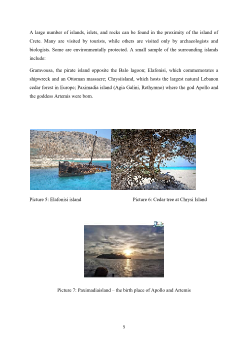
A large number of islands, islets, and rocks can be found in the proximity of the island of
Crete. Many are visited by tourists, while others are visited only by archaeologists and
biologists. Some are environmentally protected. A small sample of the surrounding islands
include:
Gramvousa, the pirate island opposite the Balo lagoon; Elafonisi, which commemorates a
shipwreck and an Ottoman massacre; Chrysiisland, which hosts the largest natural Lebanon
cedar forest in Europe; Paximadia island (Agia Galini, Rethymno) where the god Apollo and
the goddess Artemis were born.
Picture 5: Elafonisi island
Picture 6: Cedar tree at Chrysi Island
Picture 7: Paximadiaisland – the birth place of Apollo and Artemis