1
Course in English Morphology
Summer Term 2019/20
Instructor: Valentina Budincic
2
INTRODUCTION TO ENGLISH WORD FORMATION PROCESSES
Morphology
is the study of language which deals with words, word formation and word
classification. The term morphology comes from Greek word ‘moarphe’ meaning
form
and
‘logia’ meaning
learning
.
SUBRANCHES OF MORPHOLOGY
1. Inflection
2. Word formation (Derivation & Compounding)
3. Affixation (Prefixattion & Suffixation & Infixation)
4. Non-affixation (Conversion & Truncation & Blending)
Term
Word
is used intuitively in everyday language for a basic element of language.
There are numerous linguistic attempts at defining the concept of word, which are not
uniform and remain controversial. Here are some principles upon which words can be
defined:
(a) phonetic-phonological level: words are the smallest segments of sound that can be
theoretically isolated by word accent and
boundary markers
like
pauses,
clicks, and the
like;
(b) orthographic-graphemic level: word is any sequence of letters bounded on either side
by blank spaces in writing or print;
(c) morphological level: words are characterized as the basic elements of grammatical
paradigms like
inflection
and are distinguished from the morphologically characterized
word forms,
cf.
write
vs.
writes, wrote, written
; they are structurally stable and cannot be
divided, and can be described as well by specific rules of
word formation;
(d) lexical-semantic level: words are the smallest, relatively independent carriers of
meaning that are codified in the lexicon;
(e) syntactical level: the smallest permutable and substitutable units of a sentence.
WORD CLASSIFICATION
All words in language can be classified into two groups: grammatical words and lexical
words.
Grammatical words
are pronouns, conjunctions, prepositions, articles and auxiliary verbs.
They are also known as functional words. Their number is finite.
Lexical words are
nouns, adjectives, adverbs and verbs. They are also known as full or
content words. Their number is potentially unlimited.
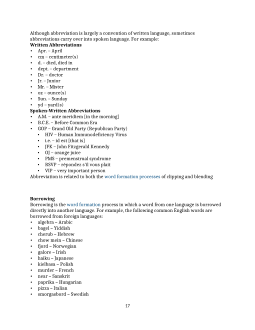
PARTS OF SPEECH
4
SIMPLE, COMPLEX WORDS & COMPOUND WORDS
•
Simple
words consist of a single free base. e.g. spirit, long, free
•
Complex
words contain, as their immediate constituents, either two bound forms or
a bound and a free form.
e.g. two bound forms:
matri
cide,
tele
vise
e.g. bound and free forms:
lion
ess,
eras
er
•
Compounding
is the process of combining two or more words (free morphemes) to
create a new word.
•
Compound words
have free forms, usually two, as their immediate constituents
(IC).
e.g. green
house
, under
go
•
A small number of compound words have three or four free forms as coordinate ICs.
e.g. point-of-view, jack-of-all-trades
Compounds are written as:
1. one word (lipstick). They are called closed compounds.
2. two-hyphenated words (marry-go-round, well-being)
3. two separate words (football stadium, school bus, grapefruit juice). They are
called open compounds.
In each case compounds function as single units of meaning.
•
Compound words
cannot be divided by the insertion of intervening material
between the two parts, but
grammatical structures
can be so divided.
e.g. She is a sweetheart. (compound word)
She has a sweet heart. (grammatical structure)
Grammatical structure
can be divided by the insertion of intervening material between
the two parts.
e.g. She has a
sweater
heart than her sister.
She has a
sweet
, kind heart.
5
TYPES OF COMPOUNDS
Endocentric
A+B, where B is the head: e.g. text+book, black+board, sun+glasses, darkroom, smalltalk
Exocentric
A+B, where there is no expressed semantic head: e.g. four+eyes (person), spoilsport,
pickpocket, wagtail, breakwater, breakfast, turncoat, hatch-back (car), cutthroat (person)
Appositional
A and B provide different descriptions for the same referent:
e.g. maid-servant, hunter-gatherer, actor-manager, actor-director, player-coach
Copulative
A+B denotes ‘the sum’ of what A and B denote: e.g. red-orange, bitter-sweet
Rhyming Compounds
e.g. ding-dong, willy-nilli, hanky-panky, mumbo-jumbo, hoity-toity, hocus-pocus, snailmail,
backpack, fro-yo (frozen yogurt), boogie-woogie, roly-poly, hanky-panky, romcom
(romantic comedy), bofro ( boyfriend), chalk-talk (lecture with illustrations on the board),
okie-dokie, see-saw, pell-mell, mish-mash, tick-tock
Reduplicative Compounds
e.g. chi-chi, wee-wee, ack ack,
THE MORPHOLOGY OF ENGLISH: COMPOUNDING & DERIVATION
COMPOUNDING
Compounding = Combining two or more words to form a new one. Compounds do not
neccessarily bear a meaning wich is the combination of the meaning of their consituents.
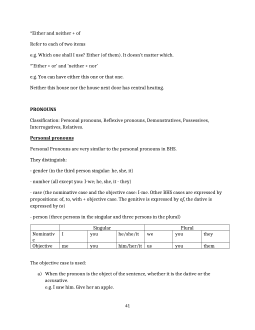
COMPOUND NOUNS
NOUN+NOUN
7
VERB+NOUN
: shunpike, (noun: shunpiker)
VERB+VERB
: (rare) make do, dare say, trickle-irrigate (can ne noun+verb, or it is back
formation from:trickle-irrigation)
ADJECTIVE+VERB
: double-book, fine-tune, free-associate, soft-land (this type arises
through back-formation or conversion)
PARTICLE+VERB
: outachieve, overachieve, overbook, overeducate, overmark (an exam
paper)
ADJECTIVE+NOUN
: brown-bag, bad-mouth
NOUN+NOUN
: to breath-test (conversion of a compound noun)
COMPOUND ADJECTIVES
NOUN+ADJECTIVE
:
capital-intensive, card-carrying, childproof, clotheared, crashworthy,
flightworthy, host-specific, leadfree, machine readable, space-borne
VERB+ADJECTIVE
: fail safe
ADJECTIVE+ ADJECTIVE
: bitter-sweet, deaf-mute, double-helical, large-statured, open-
ended, ready-made
ADVERB+ADJECTIVE
: cross-modal, over-qualified, uptight
NOUN+NOUN
: back-street (abortionist), coffee-table (book), glassteel (sky-scraper)
VERB+NOUN
: break-bulk (consignment), roll-neck (sweater), turn-key (contract)
ADJECTIVE+NOUN
: broad-brush (estimate), grey-collar (worker), red-brick (university),
solid-state (physics)
PARTICLE+NOUN
: before-tax (profits), in depth (study)
NOUN+VERB
: (doesn’t exist, since the verb turns up as a present or past participle and
hence becomes classified as an adjective)
VERB+VERB
: make-believe, go-go (dancer), pass-fail (test), stop-go (economics)
ADJECTIVE/ADVERB + VERB
: high-rise (tower), quick-change (artiste)
VERB+PARTICLE
: see-through (blouse), tow-away (zone), wrap-around (skirt)