The Oxford Dictionary of New Words:
A popular guide to words in the news
PREFACE Preface
This is the first dictionary entirely devoted to new words and meanings to
have been published by the Oxford University Press. It follows in the
tradition of the Supplement to the Oxford English Dictionary in attempting
to record the history of some recent additions to the language, but,
unlike the Supplement, it is necessarily very selective in the words,
phrases, and meanings whose stories it sets out to tell and it stands as
an independent work, unrelated (except in the resources it draws upon) to
the Oxford English Dictionary.
The aim of the Oxford Dictionary of New Words is to provide an informative
and readable guide to about two thousand high-profile words and phrases
which have been in the news during the past decade; rather than simply
defining these words (as dictionaries of new words have tended to do in
the past), it also explains their derivation and the events which brought
them to prominence, illustrated by examples of their use in journalism and
fiction. In order to do this, it draws on the published and unpublished
resources of the Oxford English Dictionary, the research that is routinely
carried out in preparing new entries for that work, and the word-files and
databases of the Oxford Dictionary Department.
What is a new word? This, of course, is a question which can never be
answered satisfactorily, any more than one can answer the question "How
long is a piece of string?" It is a commonplace to point out that the
language is a constantly changing resource, growing in some areas and
shrinking in others from day to day. The best one can hope to do in a book
of this kind is to take a snapshot of the words and senses which seem to
characterize our age and which a reader in fifty or a hundred years' time
might be unable to understand fully (even if these words were entered in
standard dictionaries) without a more expansive explanation of their
social, political, or cultural context. For the purposes of this
dictionary, a new word is any word, phrase, or meaning that came into
popular use in English or enjoyed a vogue during the eighties and early
nineties. It is a book which therefore necessarily deals with passing
fashions: most, although probably not all, of the words and senses defined
here will eventually find their way into the complete history of the
language provided by the Oxford English Dictionary, but many will not be
entered in smaller dictionaries for some time to come, if at all.
It tends to be the case that "new" words turn out to be older than people
expect them to be. This book is not limited to words and senses which
entered the language for the first time during the eighties, nor even the
seventies and eighties, because such a policy would mean excluding most of
the words which ordinary speakers of English think of as new; instead, the
deciding factor has been whether or not the general public was made aware
of the word or sense during the eighties and early nineties. A few words
included here actually entered the language as technical terms as long ago
as the nineteenth century (for example, acid rain was first written about
in the 1850s and the greenhouse effect was investigated in the late
nineteenth century, although it may not have acquired this name until the
1920s); many computing terms date from the late 1950s or early 1960s in
technical usage. It was only (in the first case) the surge of interest in
environmental issues and the sudden fashion for "green" concerns and (in
the second) the boom in home and personal computing touching the lives of
large numbers of people that brought these words into everyday vocabulary
during the eighties.
There is, of course, a main core of words defined here which did only
appear for the first time in the eighties. There are even a few which
arose in the nineties, for which there is as yet insufficient evidence to
say whether they are likely to survive. Some new-words dictionaries in the
past have limited themselves to words and senses which have not yet been
entered in general dictionaries. The words treated in the Oxford
Dictionary of New Words do not all fall into this category, for the
reasons outlined above. Approximately one-quarter of the main headwords
here were included in the new words and senses added to the Oxford English
Dictionary for its second edition in 1989; a small number of others were
entered for the first time in the Concise Oxford Dictionary's eighth
edition in 1990.
The articles in this book relate to a wide range of different subject
fields and spheres of interest, from environmentalism to rock music,
politics to youth culture, technology to children's toys. Just as the
subject coverage is inclusive, treating weighty and superficial topics as
even-handedly as possible, so the coverage of different registers, or
levels of use, of the language is intended to give equal weight to the
formal, the informal, and examples of slang and colloquialism. This
results in a higher proportion of informal and slang usage than would be
found in a general dictionary, reflecting amongst other things the way in
which awareness of register seems to be disappearing as writers
increasingly use slang expressions in print without inverted commas or any
HOWTO.1 Full entries
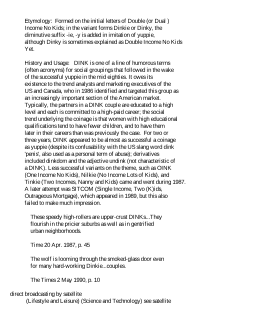
Full entries normally contain five sections:
1. Headword section
The first paragraph of the entry, or headword section, gives
° the main headword in large bold type
Where there are two different headwords which are spelt in the
same way, or two distinct new meanings of the same word, these are
distinguished by superior numbers after the headword.
° the part of speech, or grammatical category, of the word in italic
type
In this book, all the names of the parts of speech are written out
in full. The ones used in the book are adjective, adverb,
interjection, noun, pronoun, and verb There are also entries in
this book for the word-forming elements (combining form, prefix,
and suffix) and for abbreviations, which have abbreviation in the
part-of-speech slot if they are pronounced letter by letter in
speech (as is the case, for example, with BSE or PWA), but acronym
if they are normally pronounced as words in their own right (Aids,
NIMBY, PIN, etc.).
When a new word or sense is used in more than one part of speech,
the parts of speech are listed in the headword section of the
entry and a separate definition section is given for each part of
speech.
° other spellings of the headword (if any) follow the part of speech
in bold type
° the subject area(s) to which the word relates are shown at the end
of the headword section in parentheses (see "Subject Areas" in
topic HOWTO.5).
The subject areas are only intended to give a general guide to the
field of use of a particular word or sense. In addition to the
subject area, the defining section of the entry often begins with
further explanation of the headword's application.
2. Definition section
The definition section explains the meaning of the word and sometimes
contains information about its register (the level or type of language
in which it is used) or its more specific application in a particular
field; it may also include phrases and derived forms of the headword
(in bold type) or references to other entries. References to other
entries have been converted to hypertext links.
3. Etymology
The third section of the entry begins a new paragraph and starts with
the heading Etymology: This explains the origin and formation of the
headword. Some words or phrases in this section may be in italic type,
showing that they are the forms under discussion. Cross-references to
other headwords in this book have been converted to hypertext links.
4. History and Usage
The fourth section also begins a new paragraph and starts with the
heading History and Usage. Here you will find a description of the
circumstances under which the headword entered the language and came
into popular use. In many cases this section also contains information
about compounds and derived forms of the headword (as well as some
other related terms), all listed in bold type, together with their
definitions and histories. As elsewhere in the entry, cross-references
to other headwords have been converted to hypertext links.
5. Illustrative quotations
This final section of the entry begins a new paragraph and is indented
approximately 5 character spaces from the left margin of the previous
text line. These illustrative quotations are arranged in a single
chronological sequence, even when they contain examples of a number of
different forms. The illustrative quotations in this book do not
include the earliest printed example in the Oxford Dictionaries
word-file (as would be the case, for example, in the Oxford English
Dictionary); instead, information about the date of the earliest
quotations is given in the history and usage section of the entry and
the illustrative quotations aim to give a representative sample of
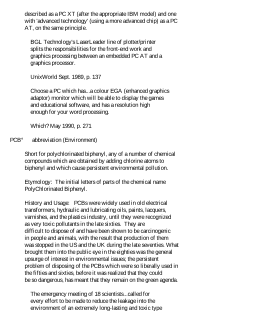
The full and cross-reference entries in this book are arranged in a single
alphabetical sequence in letter-by-letter alphabetical order (that is,
ignoring spaces, hyphens, and other punctuation which occurs within them).
The following headwords, taken from the letter E, illustrate the point:
E°
Eý
e°
earcon
eco
eco-
ecobabble
ecological
ecu
E-free
EFTPOS
enterprise culture
enterprise zone
E number
HOWTO.4 Pronunciation Symbols
Pronunciation symbols which follow the headword in printed copy have been
excluded from this soft-copy edition. In-line pronunciation symbols have
been replaced with /--/.
HOWTO.5 Subject Areas
The subject areas in parentheses at the end of the headword section of
each entry indicate the broad subject field to which the headword relates.
The subject areas used are:
Drugs words to do with drug use and abuse
Environment words to do with conservation, the environment, and green
politics
Business World words to do with work, commerce, finance, and marketing
Health and Fitness