Total quality management, market competition and
organizational performance
Vincent K. Chong
a,
*, Michael J. Rundus
b
a
UWA Business School, The University of Western Australia, 35 Stirling Highway, Crawley, WA 6009, Australia
b
Ernst and Young, 152 st. George Tce, Perth, WA 6000, Australia
Received 9 October 2001; revised 4 July 2003; accepted 3 October 2003
Abstract
This study examines the interactive effects of total quality management (TQM) practices, and
intensity of market competition on organizational performance. The responses to a questionnaire
survey of 89 production and operation managers, drawn from a cross-section of Australia
manufacturing companies, were analyzed using a multiple regression technique. The results show
that the higher the degree of market competition, the more positive the relationship between the
TQM practices of customer focus and organizational performance is. In addition, the results also
confirm that the higher the degree of market competition, the more positive the relationship between
TQM practices of product design and organizational performance.
q
2003 Elsevier Ltd. All rights reserved.
Keywords:
Total quality management practices; Market competition; Organizational performance
1. Introduction
The past decade has witnessed a remarkable spread in the use of total quality
management (TQM) practices in both manufacturing and non-manufacturing firms.
Intense competition in the marketplace has caused manufacturing firms to search for a
competitive edge in their manufacturing operations and processes. It has been argued that
the use of TQM practices has a synergistic impact on organizational performance
(
Schonberger, 1986; Cobb, 1993
). Some studies have found that the use of TQM practices
reduces manufacturing process variance, eliminates reworks and scraps, and improves
quality performance (see
Daniel and Reitsperger (1991), Flynn et al. (1995) and
0890-8389/$ - see front matter
q
2003 Elsevier Ltd. All rights reserved.
doi:10.1016/j.bar.2003.10.006
The British Accounting Review 36 (2004) 155–172
www.elsevier.com/locate/bar
* Corresponding author. Tel.:
þ
61-8-9380-2914; fax:
þ
61-8-9380-1047.
E-mail address:
[email protected] (V.K. Chong).
Schmenner and Cook (1985)
). In addition, there is considerable anecdotal evidence
(
Crosby, 1984; Hayes and Wheelwright, 1984; Gerwin, 1987; Harmon and Peterson,
1990
) on the extent to which TQM initiatives enhance the potential for firms to improve
their performance. More recently, empirical evidence suggests that there are direct and
indirect relationships between the adoption of TQM practices and firms’ performance
levels (
Hendricks and Singhal, 2001; Kaynak, 2003
). Other researchers have, however,
expressed reservations about the benefits of TQM practices as a feasible and cost effective
initiative (
Schaffter and Thomson, 1992; Naj, 1993
). Moreover, some studies have found
that TQM firms do not outperform non-TQM firms (
Mathews, 1992; Fuchsberg, 1993
).
Despite this, some researchers claim that the disappointing results of TQM practices may
be attributed to inadequate resources, negligence in making complimentary investments in
organizational structure and human resources, and inadequate appreciation of system
dynamics (
Powell, 1995; Sterman et al., 1997
). Other studies assert that the poor
performance of many new TQM initiatives are due, in part, to the continuous reliance on
management accounting systems that fail to provide relevant information (
Kaplan, 1983;
Johnson and Kaplan, 1987
; see also
Gurd et al. (2002)
).
Gurd et al. (2002)
, for example,
examine the factors that either encourage or inhibit accounting lag following the
implementation of TQM practices. Specifically, they found that industry sectors,
management commitment, organizational structure, participation, and financial perform-
ance, have an impact on accounting lag.
Banker et al. (1998, p. 1179)
note that, “…if increased competition is the primary basis
for the renewed focus on quality today, it is important to understand how the quality
improvement decision of a firm is linked to its competitors’ choice of quality levels and the
degree of competitive intensity between the firms”. However, the issue of how TQM
initiatives are influenced by the intensity of market competition has received only scant
attention in the empirical literature on management accounting. The need to address this
gap in the literature arises from increasing concern over under performing TQM
initiatives, and questions about the relevance of quality strategies in a highly competitive
environment (
Taylor, 1992; Fuchsberg, 1993
). Our study is motivated by the lack of
empirical evidence on the impact of intensity of market competition on the relationship
between the use of TQM practices and organizational performance.
The remainder of the paper is organized as follows. Section 2 discusses the theory and
the research hypotheses to be tested. Section 3 addresses the research method while
Section 4 presents the empirical results. Section 5 presents the discussion and conclusion
of the paper.
2. Theoretical development and hypotheses
TQM practices are management techniques involving the measurement of actual
manufacturing performance against rigorous quality standards. The core ideas of TQM
practices include seeking opportunities to increase customer satisfaction, striving for
continuous improvement and doing things right the first time (
Schonberger, 1986; Gunn,
1987; Harrington, 1987
). We rely on the seminal works on TQM as the basis for our
theoretical arguments (see the works of
Crosby (1979, 1996), Deming (1982, 1986),
V.K. Chong, M.J. Rundus / The British Accounting Review 36 (2004) 155–172
156
1995; Ahire and Dreyfus, 2000
; see also
Kaynak (2003)
). Thus,
it can be concluded that
TQM practices that focus on product design are positively associated with organizational
performance
.
2.1. The role of intensity of market competition
Thus far, it has been argued that the use of TQM practices are likely to lead to improved
organizational performance; but this is subject to one qualification that relates to the
degree of intensity of market competition. Manufacturing organizations face different
degrees of market competition. Contingency theory suggests that an organization must be
aligned with its environment to achieve optimal performance (
Hayes, 1977
). Market
competition is a key situational factor in the total number of factors that comprise the
firm’s environment. This study conceptualized market competition as consisting of price,
product differentiation, product distribution and other market factors such as (1) the
number of major competitors operating in the market, (2) the frequency of technological
changes in the industry, (3) the frequency with which new products are introduced, (4) the
extent of price cuts, (5) package deals for customers offered by competitors, and (6)
changes in government regulations and policy (see
Khandwalla (1972) and Mia and Clarke
(1999)
). With increased competition in organizations’ market places, we argue that the
performance of manufacturing firms is likely to deteriorate if they fail to adopt an
appropriate manufacturing strategy (such as the use of TQM practices) to deal with the
competitive threats and challenges. Prior studies (
Schlesinger and Heskett, 1991; Banker
et al., 1996
) argued that increased market competition has led many firms to emphasize
customer focus and product design services in order to enhance customer satisfaction and
gain a competitive edge.
Banker et al. (1996)
argued that to be able to maintain old
customers and to win new customers is necessary for maintaining and improving market
share and profitability. Thus, the higher the intensity of market competition, the more
aggressive a business must be in discovering customer needs, and to enhance customer
satisfaction (
Kohli and Jaworski, 1990
).
Das et al. (2000)
suggest that when firms face
market competition, they have to produce and market high quality products to meet
customer and competitive quality standards. They further suggest that quality-related
investments (i.e. TQM practices based on customer focus and product design) associated
with increased market competition should result in improved products and services,
which, in turn, should lead to higher levels of customer satisfaction. The quality literature
(
Ittner and Larcker, 1996; Nilsson et al., 2001
) found that, in general, higher levels of
customer satisfaction leads to a higher level of organizational performance.
Based on the foregoing discussions, we test the following two hypotheses: (1) the
higher the degree of market competition, the more positive the relationship between TQM
practices based on customer focus and organizational performance, and (2) the higher the
degree of market competition, the more positive the relationship between TQM practices
pertaining to product design and organizational performance. Accordingly, our
hypotheses, stated in alternative forms, are shown as follows:
H1: The higher the degree of market competition, the more positive the relationship
between TQM practices of customer focus and organizational performance.
V.K. Chong, M.J. Rundus / The British Accounting Review 36 (2004) 155–172
158
H2: The higher the degree of market competition, the more positive the relationship
between TQM practices of product design and organizational performance.
3. Method
A total of 220 large manufacturing firms located in Melbourne, Victoria, were chosen
from
Kompass Australia (1996)
. The criteria for inclusion in the sample were as follows:
(1) the firms have adopted and used new manufacturing practices for at least 3 years, and
(2) the manufacturing firms must have at least 100 employees in the organization.
1
From
the 220 companies, the names of 178 managers were identified. Telephone calls were
made to each manager to ensure that they were willing to participate in the project. A total
of 147 managers agreed to participate in the project. Each participant was sent a survey
questionnaire, together with a covering letter and a prepaid self-addressed envelope for the
questionnaire to be returned directly to the researchers. Questionnaires were pre-coded to
enable non-respondents to be traced and follow-up to be executed. Follow-up of the
questionnaire was sent to those who had not responded after 3 weeks. A total of 147
questionnaires were sent and 105 questionnaires were returned, making a response rate of
71.43%. Of the 105 responses, 12 were excluded from the study for incomplete responses
and four for unreliable responses.
2
This left the study with 89 useable responses for the
final data analysis. On average, the respondents had worked for their present company for
11 years, and had been in their current position for 5.5 years. The average number of
employees in the respondents’ areas of responsibility was 90, and the companies had an
average of 345 employees.
To test for non-response bias, we adopt an approach suggested by
Oppenheim (1966)
.
The results reveal that there were no statistically significant differences in the mean scores
between the early and late responses.
3.1. The measurement of variables
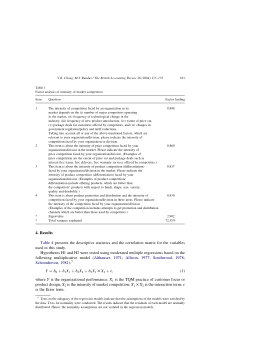
Intensity of market competition
. Intensity of market competition was measured by a
four-item instrument adapted from
Khandwalla (1972) and Mia and Clarke (1999)
.
Respondents were asked to indicate the intensity of market competition in their
organizations’ market on a seven-point Likert-type scale anchored at (1) very low
1
It is assumed that firms with less than 100 employees are not likely to have clearly defined areas of
responsibilities (
Brownell and Dunk, 1991
), and, therefore, such firms are most unlikely to adopt and use new
manufacturing practices.
2
Four responses were considered as outliers. Three responses were firms, which have employed more than
4500 employees. The first firm employed 4500 people, while the second firm employed 5000 people. The third
firm employed 18 000 employees. The fourth firm employs less than 100 employees. (Recall, that one of the
criteria for sample inclusion was that the manufacturing firms must have at least 100 employees in the
organization.) This firm has only employed 34 employees. The regression analyses were repeated before the four
responses were excluded. The results revealed that there were no significant differences between the regression
results based on 93 responses (before excluding the four responses) and those based on 89 responses (after
excluding the four responses).
V.K. Chong, M.J. Rundus / The British Accounting Review 36 (2004) 155–172
159