UNIVERZITET “MB” BEOGRAD
POSLOVNI I PRAVNI FALKUTET
SEMINAR PAPER
SUBJECT
:
Engleski jezik II
THEME:
NOUNS
1
STUDENT:
CONTENTS
1.
NOUNS…………………………………………………………………………………3
1.1
ONE-WORD NOUNS………………………………………………………...………3
1.2
COMPOUND NOUNS………………………………………………………………..3
1.3
NOUNS CLASSIFICATION………………………………………………………….4
1.4
COUNTABLE AND UNCOUNTABLE NOUNS……………………………………5
1.5
DETERMINERS………………………………………………………………………6
2.
PROPERTIES OF NOUNS………………………………………………………...…...8
2.1
GENDER…………………………………………...……………………………..…...8
2.2
NUMBER…………………………………………………………………………….10
2.3
CASE………………………………………….……………………………………...14
BIBLIOGRAPHY…………………………….…………………………………………..17
2
Frank sent
his boss
a telex
.
3
- the object of a proposition:
I read about it in
the paper
.
- the complement of be or a related verb like seem:
Bill Gates is
our guest
.
- used 'in apposition':
Laura Myers, a BBC reporter
,
asked for an interview
.
4
- used when we speak directly to somebody:
Ann
,
shut that window, will you please
?
1.2 Compound nouns:
Many nouns in English are formed of two parts (
classroom
) or, less
commonly, three or more (
son-in-law, stick-in-the-mud
).Sometimes
compounds are spelt with a hyphen, sometimes not. There are no precise
rules, so the following are brief guidelines:
1. When two short nouns are joined together, they form one word without
a hyphen (
a teacup
). We do not join two short nouns if this leads to
problems of recognition: bus stop (not
busstop
).
2. Hyphens are often used for verb + particle combinations (
make-up
) and
self-combinations (
self-respect
).
3. When a compound is accepted as a single word (it has an entry in a
dictionary the tendency is to write it as one word `sunbathing`). In other
cases, the use of the hyphen is at the discretion of the writer (
writing
paper or writing-paper
), but the tendency is to avoid hyphens where
possible.
1.3 Nouns classification
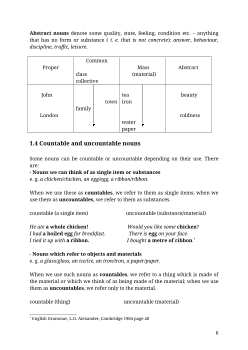
PROPER: India
3
Ibid, page 32
4
Ibid, page 32
4
CONCRETE: a book
NOUN
COUNTABLE
ABSTRACT: an idea
COMMON:
CONCRETE: clothing
UNCOUNTABLE
ABSTRACT: courage
We distinguish two kinds of nouns:
1.
Proper nouns
– denote one particular person, place or thing. These
nouns have no plural:
John, London, the Danube, October.
2.
Common nouns –
denote a person, place or thing as one of a class or a
group:
man, town, river, month, table.
Common nouns are sometimes called
class nouns
. These nouns usually have a
plural. When a common noun denotes a thing which is itself a group of other
things or persons, it is called a
collective noun
.
A collective noun
denotes a group of persons or things regarded as one. A
collective noun is singular in number:
army, band, family, team, crowd.
The verb and the pronoun used with a collective noun can be in the singular or
in the plural. If we are thinking of the group collectively, the singular is used. If
individually, the plural is used.
The
class
is going for its annual trip
.
5
The
class
differ
in their opinion where to go
.
6
Mass nouns
denote a formless mass or material (
material nouns
). They
usually have no plural:
tea, sand, water, iron, paper
.
5
An Outline of English Grammar, dr.Rudolf Filipovic, Zagreb 1986 page 21
6
Ibid, page 21
5