„
”
Гимназија Урош Предић
[email protected]
5, 26000
Игњата Барајевца
Панчево
[email protected]
/
013/301-120, 344-483
Тел Факс
www.gimnazijaurospredic.edu.rs
МАТУРСКИ РАД
Предмет:
Енглески
Тема:
The Niagara Falls
Ментор:
Цигановић Снежана
Ученик:
Вршка Катарина
Одељење:
IV - 8
Потпис
Панчево, јун 2014.
Contents:
1. Preamble …………………………………………………………………………………….... 2
2. Traits ………………………………………………………………………………………….. 3
3. Geology ………………………………………………………………………………………... 3
4. History ………………………………………………………………………………………… 5
5. Power …………………………………………………………………………………………... 6
6. Transport ……………………………………………………………………………………... 9
7. Preservation efforts …………………………………………………………………………… 9
8. Over the falls ………………………………………………………………………………….. 11
9. Movies and television ……………………………………………………………………….. 13
10. Music …………………………………………………………………………………………. 13
11. Tourism ……………………………………………………………………………………….. 14
12. Art …………………………………………………………………………………………….. 15
2
2. Traits
The Horseshoe Falls drop about 53 m, while the height of the American Falls varies between 21–30 m
because of the presence of giant boulders at its base. The larger Horseshoe Falls are about 790 m wide,
while the American Falls are 320 m wide. The distance between the American extremity of the Niagara
Falls and the Canadian extremity is 1,039 m.
The volume of water approaching the falls may sometimes be as much as 6,400 m
3
per second. The
average annual flow rate is 2,400 m
3
. During the summer months, at least 2,800 m
3
per second of water
traverses the falls, some 90% of which goes over the Horseshoe Falls, while the balance is diverted to
hydroelectric facilities. This is accomplished by employing a weir with movable gates upstream from the
Horseshoe Falls. The falls flow is further halved at night, and during the low tourist season in the winter,
remains a minimum of 1,400 m
3
per second. Water diversion is regulated by the 1950 Niagara Treaty and
is administered by the International Niagara Board of Control (IJC).
Picture no. 1 Green water of Niagara Falls
The green colour of the water flowing over the Niagara Falls is a byproduct of the estimated 60
tonnes/minute of dissolved salts and "rock flour" (very finely ground rock) generated by the erosive force
of the Niagara River itself. The current rate of erosion is approximately 0.30 m per year down from a
historical average of 0.91 m per year. It is estimated that 50,000 years from now the remaining 32 km to
Lake Erie will have been undermined and the falls will cease to exist.
3.Geology
Wisconsin glaciation, the force that created the North American Great Lakes and the Niagara River, also
created the Niagara Falls about 10 000 years ago. All were dug by a continental ice sheet that drove
through the area, deepening some river channels to form lakes, and damming others with ruins. Scientists
argue that there is an old valley that is buried by glacial drift at the approximate location of the present
Welland Canal.
4
When the ice melted, the upper Great Lakes emptied into the Niagara river, which followed the rearranged
topography across the Niagara Escarpment. In time, the river cut a gorge through the north facing cliff.
Because of the interactions of three major rock formations, the rocky bed did not erode evenly. Picture no.
2 shows the hard caprock, the Lockport Formation (Middle Silurian), which underlies the rapids above the
falls, and approximately the upper third of the high gorge wall.
Picture no. 2 Aerial view of Niagara Falls
About 10,900 years ago, the Niagara Falls was located between present-day Queenston, Ontario, and
Lewiston, New York, but erosion has caused the waterfalls to retreat approximately 10.9 km southward.
The Horseshoe Falls, which are approximately 790 m wide, have also changed their shape through the
process of erosion, evolving from a small arch, to a horseshoe bend, to the present day gigantic inverted
V. Goat Island splits the course of the Niagara River, resulting in the separation of the mostly Canadian
Horseshoe Falls to the west from the American and Bridal Veil Falls to the east. Engineering has slowed
erosion and recession.
5

Before the late 20th century the northeastern end of the Horseshoe Falls was in the United States, flowing
around the Terrapin Rocks, which was once connected to Goat Island by a series of bridges. In 1955 the
area between the rocks and Goat Island was filled in, creating Terrapin Point. In the early 1980s the
United States Army Corps of Engineers filled in more land and built diversion dams and retaining walls to
force the water away from Terrapin Point. Altogether 120 m of the Horseshoe Falls was eliminated,
including 30 m on the Canadian side. According to author Ginger Strand, the Horseshoe Falls is now
entirely in Canada.
5. Power
The enormous energy of Niagara Falls has long been recognized as a potential source of power. The first
known effort to harness the waters was in 1759, when Daniel Joncaire built a small canal above the falls to
power his sawmill. Augustus and Peter Porter purchased this area and all of American Falls in 1805 from
the New York state government, and enlarged the original canal to provide hydraulic power for their
gristmill and tannery. In 1853, the Niagara Falls Hydraulic Power and Mining Company was chartered,
which eventually constructed the canals that would be used to generate electricity. In 1881, under the
leadership of Jacob Schoellkopf, Niagara River's first hydroelectric generating station was built. The water
fell 26 m and generated direct current electricity, which ran the machinery of local mills and lit up some of
the village streets.
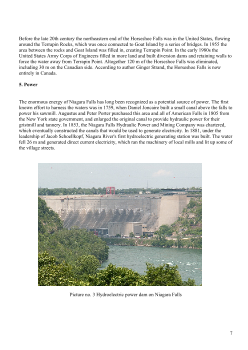
Picture no. 3 Hydroelectric power dam on Niagara Falls
7
The Niagara Falls Power Company, a descendant of Schoellkopf's firm, formed the Cataract Company
headed by Edward Dean Adams, with the intent of expanding Niagara Falls power capacity. In 1890, a
five-member International Niagara Commission headed by Sir William Thomson among other
distinguished scientists deliberated on the expansion of Niagara hydroelectric In 1893, Westinghouse
Electric was hired to design a system to generate alternating current on Niagara Falls, and three years after
that this large scale AC power system was created (activated on August 26, 1895).
By 1896 they had constructed giant underground conduits leading to turbines generating upwards of
100,000 horsepower (75 MW), and were sending power 32 km away. Some of the original designs for the
power transmission plants were created by the Swiss firm Faesch & Piccard, which also constructed the
original 5,000 HP waterwheels.
Private companies on the Canadian side also began to harness the energy of the falls.Canada eventually
brought power transmission operations under public control in 1906, distributing Niagara's energy to
various parts of the Canadian province.
Other hydropower plants were also being built along the Niagara River. But in 1956, disaster struck when
the region's largest hydropower station was partially destroyed in a landslide. The landslide drastically
reduced power production and tens of thousands of manufacturing jobs were at stake. In 1957, Congress
passed the Niagara Redevelopment Act, which granted the New York Power Authority the right to fully
develop the United States' share of the Niagara River's hydroelectric potential.
In 1961, when the Niagara Falls hydroelectric project first went on line, it was the largest hydropower
facility in the Western world. Today, Niagara is still the largest electricity producer in New York State,
with a generating capacity of 2.4 gigawatts. Up to 1,420 m
3
of water a second is diverted from the Niagara
River through conduits under the City of Niagara Falls to the Lewiston and Robert Moses power plants.
Currently between 50% and 75% of the Niagara River's flow is diverted via four huge tunnels that arise
far upstream from the waterfalls. The water then passes through hydroelectric turbines that supply power
to nearby areas of Canada and the United States before returning to the river well past the falls.This water
spins turbines that power generators, converting mechanical energy into electrical energy. When
electricity demand is low, the Lewiston units can operate as pumps to transport water from the lower bay
back up to the plant's reservoir, allowing this water to be used again during the daytime when electricity
use peaks. During peak electrical demand, the same Lewiston pumps are reversed and actually become
generators, similar to those at the Moses plant.
To preserve Niagara Falls' natural beauty, a 1950 treaty signed by the U.S. and Canada limited water
usage by the power plants.
The most powerful hydroelectric stations on the Niagara River are the Sir Adam Beck 1 and 2 on the
Canadian side and the Robert Moses Niagara Power Plant and the Lewiston Pump Generating Plant on the
American side. Together, Niagara's generating stations can produce about 4.4 gigawatts of power.
In August 2005 Ontario Power Generation, which is responsible for the Sir Adam Beck stations, started a
major civil engineering project, called the Niagara Tunnel Project, to increase power production by
building a new 12.7 metres diameter, 10.2 kilometres long water diversion tunnel. It was officially placed
into service in March 2013, helping to increase the generating complex's nameplate capacity by 150
megawatts. It did so by tapping water from farther up the Niagara river than was possible with the
preexisting arrangement. The tunnel provided new hydroelectricity for approximately 160,000 homes.
8

6.Transport
Ships can pass by Niagara Falls by means of the Welland Canal, which was improved and incorporated
into the Saint Lawrence Seaway in the mid-1950s. While the seaway diverted water traffic from nearby
Buffalo and led to the demise of its steel and grain mills, other industries in the Niagara River valley
flourished with the help of the electric power produced by the river. However, since the 1970s the region
has declined economically.
The cities of Niagara Falls, Ontario, Canada and Niagara Falls, New York, U.S.A. are connected by two
international bridges. The Rainbow Bridge, just downriver from the falls, affords the closest view of the
falls and is open to non-commercial vehicle traffic and pedestrians. The Whirlpool Rapids Bridge lies 1.6
km north of the Rainbow Bridge and is the oldest bridge over the Niagara River. Nearby Niagara Falls
International Airport and Buffalo Niagara International Airport were named after the waterfall, as were
Niagara University, countless local businesses, and even an asteroid.
7.Preservation efforts
Niagara Falls has long been a source of inspiration for explorers, travelers, artists, authors, filmmakers,
residents and visitors, few of whom realize that the falls were nearly to be solely devoted to industrial and
commercial use. In the 1870s, sightseers had limited access to Niagara Falls and often had to pay merely
for a glimpse, and industrialization threatened to carve up Goat Island in an effort to further expand
commercial development. Other industrial encroachments and lack of public access led to a conservation
movement in the U.S. known as Free Niagara, with a proposal for international discussions on the
establishment of a public park.
William Dorsheimer, moved by the scene from the Goat island, brought Olmsted to Buffalo in 1868 to
design a city park system and help promote Olmsted's career. Later, in 1879, the New York state
legislature commissioned Olmsted and James T. Gardner to survey the falls and to create a Special Report
on the preservation of Niagara Falls. The report advocated for State purchase, restoration and preservation
through public ownership of the scenic lands surrounding Niagara Falls
Preservationists' efforts were rewarded on April 30, 1885, when Governor David B. Hill signed legislation
creating the Niagara Reservation, New York's first state park. New York State began to purchase land
from developers, under the charter of the Niagara Reservation State Park. In the same year, the province
of Ontario established the Queen Victoria Niagara Falls Park for the same purpose. On the Canadian side,
the Niagara Parks Commission governs land usage along the entire course of the Niagara River, from
Lake Erie to Lake Ontario.
In 1887, Olmsted and Calvert Vaux issued a supplemental report detailing plans to restore the falls.They
planned a park with scenic roadways, paths and a few shelters designed to protect the landscape while
allowing large numbers of visitors to enjoy the falls. Commemorative statues, shops, restaurants, and a
1959 glass and metal observation tower were added later. Preservationists continue to strive to strike a
balance between Olmsted's idyllic vision, and the realities of administering a popular scenic attraction.
Erosion control efforts have always been of extreme importance. Underwater weirs redirect the most
damaging currents, and the top of the falls have also been strengthened. In June 1969, the Niagara River
10
was completely diverted away from the American Falls for several months through construction of a
temporary rock and earth dam. While the Horseshoe Falls absorbed the extra flow, the U.S. Army Corps
of Engineers studied the riverbed and mechanically bolted and strengthened any faults they found, faults
that would, if left untreated, have hastened the retreat of the American Falls. A plan to remove the huge
mound of talus deposited in 1954 was abandoned owing to cost, and in November 1969, the temporary
dam was dynamited, restoring flow to the American Falls. Even after these undertakings, Luna Island, the
small piece of land between the main waterfall and the Bridal Veil, remained off limits to the public for
years owing to fears that it was unstable and could collapse into the gorge at any time.
Picture no. 6 Rainbow Bridge
Commercial interests have continued to encroach on the land surrounding the state park, including the
construction of several tall buildings (most of them hotels) on the Canadian side. The result is a significant
alteration and urbanisation of the landscape. One study indicated it has caused the airflow near the falls to
change direction. Students at the University of Guelph demonstrated, using scale models, that as air passes
over the top of the new hotels it causes a breeze to roll down the south sides of the buildings and spill into
the gorge below the falls, where it feeds into a whirlpool of moisture and air. The inference was that a
documented rise in the number of "mist days" was a result of these breezes, where mist days refers to the
mist plume of the falls reaching landside. In 1996 there were 29 mist days recorded, but by 2003 that
number had risen to 68. Another study has discounted this opinion and linked mist production primarily to
the difference in air and water temperature at the falls. However, this study does not offer opinion as to
why mist days have been increasing just that the hotel breezes are an unlikely cause.
11

Deanne from the river only 6 m from the lip of the Horseshoe Falls at Goat Island. Minutes later,
Woodward was plucked from the roiling plunge pool beneath the Horseshoe Falls after grabbing a life
ring thrown to him by the crew of the Maid of the Mist boat.
On July 2, 1984, Canadian Karel Soucek from Hamilton, Ontario successfully plunged over the Horseshoe
Falls in a barrel with only minor injuries. Soucek was fined $500 for performing the stunt without a
license. In 1985, he was fatally injured while attempting to re-create the Niagara drop at the Houston
Astrodome. His aim was to climb into a barrel hoisted to the rafters of the Astrodome and to drop 55 m
into a water tank on the floor. After his barrel released prematurely, it hit the side of the tank and he died
the next day from his injuries.
In August 1985, Steve Trotter, an aspiring stunt man from Rhode Island, became the youngest person ever
(age 22) and the first American in 25 years to go over the falls in a barrel. Ten years later, Trotter went
over the falls again, becoming the second person to go over the falls twice and survive.Lori Martin joined
Trotter for the barrel ride over the falls. They survived the fall but their barrel became stuck at the bottom
of the falls, requiring a rescue.
On September 28, 1989, Niagara's own Peter DeBernardi (age 42) and Jeffery James Petkovich (age 25)
became the first "team" to successfully make it over the falls in a two-person barrel. The stunt was
conceived by Peter DeBenardi, who wanted to discourage youth from following in his path of addictive
drug use. Peter was also trying to leave a legacy and discourage his son Kyle Lahey DeBernardi (age 2)
from using addictive drugs. Peter DeBernardi had initially planned to have a different passenger.
However, Peter's original partner backed out, and Peter was forced to look for an alternative. Jeffery
Petkovich agreed to attempt the stunt with him. Peter claims he spent an estimated $30,000 making his
barrel, made of steel and fiberglass, which had harnesses, reinforcing steel bands, and viewing ports.
Peter's barrel also had a radio for music and news reports, rudders to help steer the barrel through the falls,
oxygen, and a well-protected video camera to record the journey over the edge. They emerged shortly
after going over with minor injuries and were charged with performing an illegal stunt under the Niagara
Parks Act.
On September 27, 1993 John "David" Munday, of Caistor Centre, Ontario, became the first known person
to survive going over the falls twice.
Kirk Jones of Canton, Michigan became the first known person to survive a plunge over the Horseshoe
Falls without a flotation device on October 20, 2003. While it is still not known whether Jones was
determined to commit suicide, he survived the 16-story fall with only battered ribs, scrapes, and bruises.
A second person survived an unprotected trip over the Horseshoe Falls on March 11, 2009 and when
rescued from the river, was reported to be suffering from severe hypothermia and a large wound to his
head. His identity has not been released. Eyewitnesses reported seeing the man intentionally enter the
water.
On May 21, 2012, an unidentified man in his early 40s became the third person to survive an unprotected
trip over the Horseshoe Falls. Eyewitness reports indicate that he "deliberately jumped" into the Niagara
River after climbing over a railing.
Other daredevils have made crossing the gorge their goal, starting with the successful passage by Jean
François "Blondin" Gravelet, who crossed Niagara Gorge in 1859. Between 1859 and 1896 there was a
wire-walking craze, and there were frequent feats over the river below the falls. One inexperienced walker
13
was able to slide down his safety rope. Only one man fell to his death, at night and under mysterious
circumstances, at the anchoring place for his wire.
These tightrope walkers drew huge crowds to witness their exploits. Their wires ran across the gorge, near
the current Rainbow Bridge, not over the waterfall itself. Among the many was Ontario's William Hunt,
who billed himself as "The Great Farini" and competed with Blondin in performing outrageous stunts over
the gorge.On three separate occasions Blondin carried his manager, Harry Colcord, on his back on the
final time being watched by the Prince of Wales.
Maria Spelterini walking a tightrope across Niagara Gorge, from the United States to Canada, with her
feet in peach baskets, 1876.
In 1876 23-year-old Italian Maria Spelterini was the only woman ever to cross the Niagara Gorge on a
tightrope, making four separate crossings over a period of 18 days. On July 12 she crossed wearing peach
baskets strapped to her feet, on July 19 blind-folded, on July 22 with her ankles and wrists manacled and
finally on July 26. Never performing again at Niagara, her personal life remains a mystery and the date
and place of her death are unknown. Tightrope crossings of the falls ended by law in 1896, when James
Hardy crossed.
On June 15, 2012, high wire artist Nik Wallenda became the first person to walk across the falls in 116
years, after receiving special permission from both governments. The full length of his tightrope was 550
m. Wallenda crossed near the brink of the Horseshoe Falls, unlike previous walkers who had crossed
farther downstream. According to Wallenda, it was the longest unsupported tightrope walk in history. He
carried his passport on the trip and was required to present it upon arrival on the Canadian side of the falls.
9.Movies and television
Already a huge tourist attraction and favorite spot for honeymooners, Niagara Falls visits rose sharply in
1953 after the release of Niagara, a movie starring Marilyn Monroe and Joseph Cotten. In 1956, the
Woody Woodpecker series released the episode Niagara Fools. Later in the 20th century, the falls was a
featured location in 1980s movie Superman II, and was itself the subject of a popular IMAX movie,
Niagara: Miracles, Myths and Magic. Much of the episode Return of the Technodrome in the 1987
Teenage Mutant Ninja Turtles cartoon series take place near the Niagara Falls and its hydroelectric plant.
Illusionist David Copperfield performed a trick in which he appeared to travel over the Horseshoe Falls in
1990. The falls, or more particularly, the tourist-supported complex near the Falls, was the setting of the
short-lived Canadian television show Wonderfalls in early 2004. More recently, location footage of the
falls was shot in October 2006 to portray "World's End" of the movie Pirates of the Caribbean: At World's
End.
10.Music
Composer Ferde Grofe was commissioned by the Niagara Falls Power Generation project in 1960 to
compose the Niagara Falls Suite in honor of the completion of the first stage of hydroelectric work at the
falls. Each movement is dedicated to the falls, or to the history of the greater Buffalo region.
Many poets have been inspired to write about the falls. Among them is the Cuban poet Jose Maria Heredia
who wrote the poem "Niagara". There are commemorative plaques on both sides of the falls recognising
the poem.
14

12. Art
Picture no.9 Louis Rémy Mignot, Niagara, Brooklyn Museum
Picture no.10 Arthur Parton, Niagara Falls, Brooklyn Museum
Picture no.11 Thomas Cole, Distant View of Niagara Falls, Art Institute of Chicago
16
Literature
1.
www.en.wikipedia.org
(
www.en.wikipedia.org/wiki/Niagara_Falls
) 25.05.2014.; 13:25
2. Petros Kapnistos, Deagostini “ATLAS SVET NA DLANU”
3.
www.teslasociety.com
17