Master work
Theme: Approach to business intelligence in electronic
operations
MENTOR:
STUDENT:
Prof. dr Angelina Njeguš
Suhila Abdoua Mohamed
Belgrade, 2015.
Content:
INTRODUCTION 3
1.
INFORMATION SYSTEMS OPERATIONS 5
1.1. EVOLUTION OF BUSINESS INFORMATION SYSTEMS 5
1.1.1.
Host-based queries 5
1.1.2.
Data warehouse 6
1.1.3.
Business Intelligence (BI) 7
2.
BUSINESS INTELLIGENCE 8
2.1. DEFINITION OF BUSINESS INTELLIGENCE 8
2.2. REASONS FOR THE IMPLEMENTATION OF BUSINESS INTELLIGENCE 9
2.3. TECHNIQUES FOR INTEGRATION OF BUSINESS INTELLIGENCE 10
2.3.1.
Integration into enterprise portals 11
2.3.2.
Incorporation of analytical methods in operational applications 12
2.3.3.
Web services 13
2.4. Types of business intelligence applications 14
3.
DATA WAREHOUSE 16
3.1. TERM OF DATA WAREHOUSE 16
3.2. OPERATING AND INFORMATION DATABASE (OLTP vs. OLAP) 17
3.2.1.
OLAP cube data 19
3.2.2.
Types of organizing data in OLAP-in 20
3.2.3.
The ratio of multidimensional analysis and SQL Access 20
3.3. Data Warehouse architecture 21
3.3.1.
Data Sources 22
3.3.2.
Extraction / duplication of data (Extraction / Propagation) 22
3.3.3.
Transformation / data cleansing 22
3.3.4.
Processing of data (Data refining) 23
3.3.5.
The physical database model 23
3.3.6.
Logical database model 24
3.3.6.1. Contents Table 24
3.3.6.2. Table of Contents Table of dimensions 24
3.3.7.
Meta data 26
3.3.7.1. Types of meta-data 27
3.3.8.
Source of operational data (ODS) 27
3.3.9.
Data March 28
3.3.10.
Analysis and Presentation tools 28
4.
DATA MINING 30
4.1. KNOWLEDGE DISCOVERY AND DATA MINING 30
4.2. DEVELOPMENT OF DATA MINING 32
4.3. TERM DATA MINING 33
1
INTRODUCTION
Each company represents a dynamic system, which is characterized by its current status as well
as the situation in which the system can go into the future. These conditions are expressed by
means of large amounts of data, which are registered in different types of information systems,
documents, business records and other carriers of information. Processing of these data, the
correlation between them and their transformation into information represents a significant
development potential. Information is a key factor in decision-making at any level of operating
through the middle to strategic decision-making levels, and in this sense their adequate generation
and interpretation has a significant impact on the choice of management actions enterprise
management. Electronic business method becomes dominant compared to the previous methods,
productivity, efficiency and effectiveness, as a measure of success of business processes, are
directly related to the quality and level of implemented information technologies that support
these processes.
Information technology infrastructure constitute the basis for the process of business intelligence
system. Business Intelligence is part of the organization's information system specifically
developed to enable performance management organization. Business intelligence is an area in
the field of information technology, which aims to overall enterprise information resources put to
use making top quality decisions in order to achieve established strategic goals of the company.
This is a complex area that includes various types of technologies and approaches in the field of
information technology, management, statistics and mathematics.
The main objective of this paper is to define the concept of business intelligence, display basic
characteristics and present ways of integrating business intelligence into business processes. In
addition, the paper deals with the detailed description of the basic techniques and business
intelligence tools, and methodologies for displaying their implementation.
In the first chapter are given general information about business information systems, and the
causes of their application. Also presented are some types of these systems and presents their
evolutionary flow.
The second chapter deals with the general concept of business intelligence. In there are
definitions of the term business intelligence, describe techniques for integrating business
intelligence into business processes and presents the types of business intelligence applications
that are used in modern business.
The third chapter in addition to the definition of a data warehouse introduces the concepts and
processes OLAP (On-Line Analytical Processing) and gambling (Data cubes). In addition to this
paper illustrates the architecture of a data warehouse with a detailed description of all the
components from which the system is composed.
The fourth chapter of this work relates to data mining, surely one of the most complex and most
frequently used techniques of business intelligence. This chapter is based on the notion of
knowledge discovery and describes its relationship to data mining infection. Then provides an
overview of the development of data mining, defines its concept and methodology, and finally
presents briefly the techniques of data mining and unstructured data such as text mining, web
mining, and multimedia data mining.
3
In the final chapter, in order to illustrate the possibilities of practical application of business
intelligence, i.e., its techniques in the field of electronic education, provides a description of
business intelligence tools that are in SQL Server Business Intelligence Development Studio, as
well as an example of using the given tools to generate data mining models over a specific
database that is obtained from the application of distance learning - "Moodle", and database
information system of postgraduate studies at the Faculty of Organizational Sciences in Belgrade.
4
The advantage of such systems is relatively fast data access, while on the other hand, the main
disadvantage of excessive clumsiness huge amounts of data and very complex queries to access
transactional databases. This is why these information systems used mainly technical staff who
had the necessary knowledge and experience in working with computers, on the other hand
managers are getting their information directly from the technical staff themselves because they
were not able to effectively use these systems.
Figure 1: Evolution of Business Information Systems
1.1.2. Data warehouse
Data warehouse can be defined as: collection of information organized so you can easily analyze,
select, synthesize, and otherwise use in order to understand the essence of this information. Data
warehouse delivers significant features and benefits compared to the first generation of
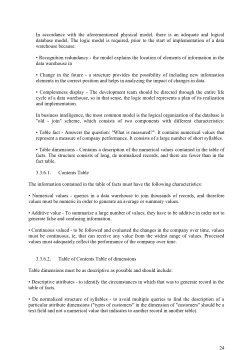
information systems:
• Data warehouse is designed to continuously meet the needs of business users, not just the daily
operational needs.
• Data warehouse information is clean, clear and consistent, without having the technical staff
interprets into a form that the user can understand.
• It also contains historical information, not just information on current operations
• Significantly improved user interface with the advent of tools for decision support.
6